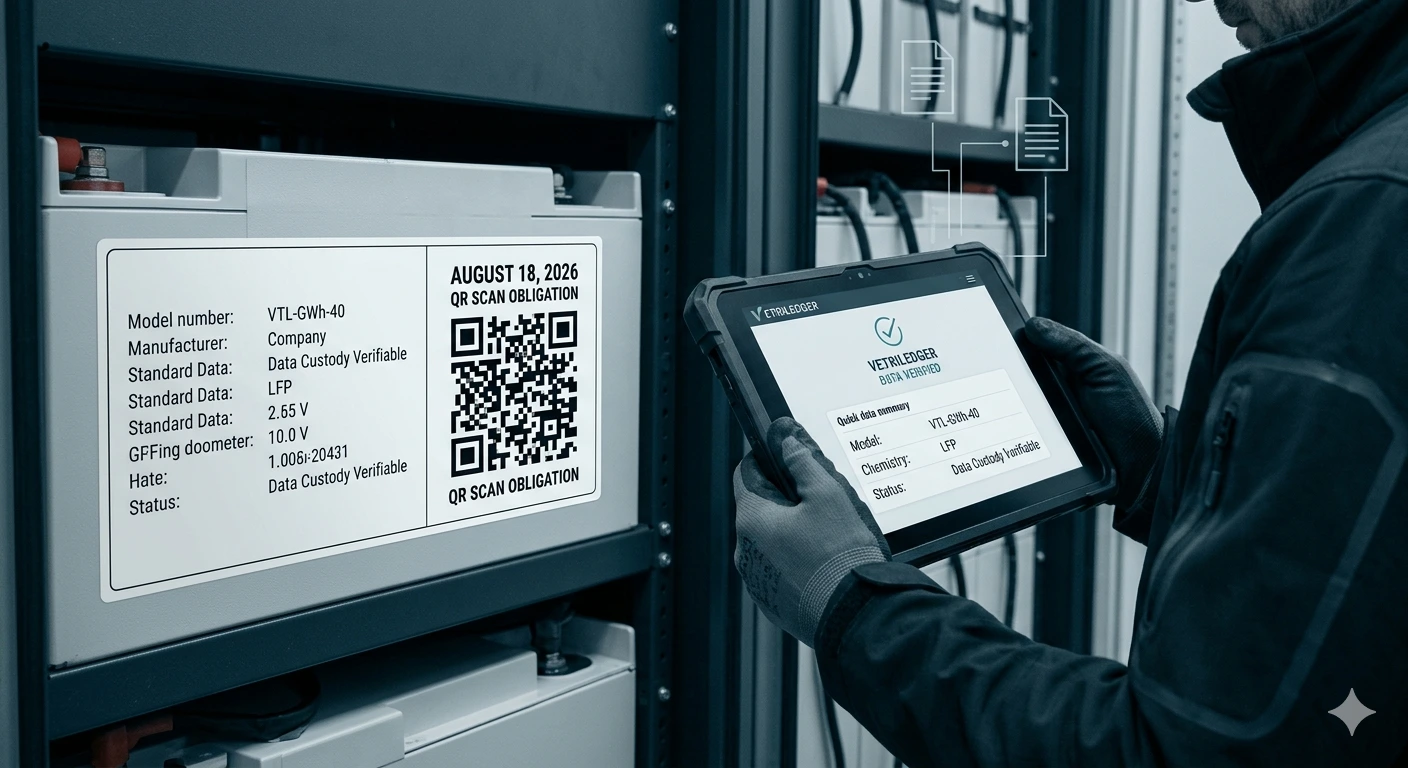
Institutional buyers and Stationary Battery Energy Storage System (BESS) operators are currently navigating a high-stakes transition from the legacy 2006 Battery Directive to the directly enforceable Regulation (EU) 2023/1542.
While the industry has focused heavily on the 2027 "Digital Battery Passport" window, a more immediate regulatory hurdle arrives on August 18, 2026. This date marks the mandatory enforcement of advanced labeling requirements and the first wave of carbon footprint performance classes that will fundamentally alter procurement economics.
For compliance managers, this is no longer a strategic discussion; it is a 90-day operational countdown. Failure to align factory origin logs with physical label data will not merely result in administrative fines but in the prohibition of sales and the immediate recall of non-compliant units already in the market.
Executive Summary: The immediate countdown to August 18, 2026
The EU Battery Regulation August 2026 deadline represents the end of the "adjustment period" for economic operators. While the regulation entered into force in February 2024, the Commission intentionally phased the most technically demanding labeling and carbon disclosure requirements to allow supply chains to digitize.
On August 18, 2024, the CE mark became mandatory for all batteries. However, the August 2026 milestone shifts the focus from safety/conformity to sustainability and traceability. For BESS and Light Means of Transport (LMT) operators, this means that every unit placed on the market must bear labels disclosing capacity, chemistry, and specific hazard information. Crucially, for Electric Vehicle (EV) batteries, this is the activation date for Carbon Footprint Performance Classes, a mechanism that will eventually be extended to industrial batteries and will determine which products are legally allowed on the EU market.
What exact technical parameters must be dynamically mapped to the mandatory August 18, 2026 QR code labels for industrial (BESS) and LMT batteries?
While the physical QR code itself becomes a universal mandate on February 18, 2027, the data infrastructure to support it must be operational by August 18, 2026 to satisfy general labeling and carbon class requirements. For BESS labeling requirements, the regulation demands a "nutrition label" style breakdown of the battery's DNA.
The following table maps the mandatory data points that must be physically present on the battery casing or accessible via the digital registry linked to the unit's unique identifier.
| Data Category | Physical Printing (On Battery/Casing) | Digital Registry (Via QR/Passport Link) |
|---|---|---|
| Identification | Manufacturer name, registered trade name, and single contact point. | Unique Identifier (UID) and batch/serial number. |
| Technical Specs | Battery category, model ID, and manufacturing date (month/year). | Rated capacity (Ah), nominal voltage, and expected service life in cycles. |
| Sustainability | Separate collection symbol (crossed-out bin). | Total Carbon Footprint (kg CO₂e/kWh) and assigned Performance Class (A-G). |
| Chemical Safety | Chemical symbols for heavy metals if Cd >0.002% or Pb >0.004%. | Detailed breakdown of materials including cobalt, lithium, and nickel compounds. |
| Circularity | N/A | Dismantling manuals, exploded diagrams, and safety measures for second-life operators. |
| Operational Health | N/A | Real-time State of Health (SOH) parameters via BMS read-only access. |
Note: The Digital Battery Passport QR code specifications require that the code be printed or engraved visibly, legibly, and indelibly. If the battery's size makes this impossible, the label must be affixed to the packaging and accompanying documentation.
How will the European Commission’s upcoming August 2026 carbon footprint "Performance Classes" impact our active battery procurement contracts?
The most significant "procurement trap" lies in Article 7, which introduces the carbon footprint declaration and subsequent performance classes. For BESS units >2kWh, a mandatory carbon footprint declaration for each battery model per manufacturing plant must be in place by February 18, 2026.
The August 18, 2026 deadline triggers the Performance Class Labeling for EV batteries, with industrial batteries following in August 2027. This class system (A to G) serves as a market differentiator and a precursor to the maximum carbon thresholds (Stage 4) that will legally ban high-emission batteries from the EU.
The "Class G" Penalty Risk
Procurement directors must be wary of the secondary data penalty. If a manufacturer cannot obtain verified primary data from their Tier 2 or Tier 3 suppliers, they are forced to use EU-approved secondary datasets. These datasets are intentionally conservative (higher emissions). Relying on unverified vendor declarations often results in a battery being pushed into a lower performance class (e.g., Class D instead of B), making the product less competitive in green procurement tenders and potentially unmarketable once maximum thresholds are enforced.
Contractual Safeguards
Current supply contracts need regulatory protection clauses that mandate:
- Primary Data Custody: Suppliers must provide company-specific datasets for "most relevant processes" (cathode materials, precursors, etc.) free of charge.
- Performance Class Guarantees: Ensuring that the calculated footprint remains below a specific threshold for the duration of the contract.
- Recalculation Triggers: If changes in the energy mix or bill of materials cause the carbon footprint to increase by more than 10%, a new declaration is required.
Who is legally liable—the manufacturer, the importer, or the Authorized Representative—if a customs audit reveals a mismatch between label data and factory origin logs?
The battery compliance liability Europe framework is designed to ensure there is always an "economic operator" established within the Union who can be held accountable for non-compliance.
1. The Importer: The De Facto Manufacturer
For BESS and LMT batteries manufactured outside the EU, the importer assumes the legal burden of the manufacturer. Before placing a battery on the market, the importer must verify that the technical documentation is complete and that the manufacturer has performed the correct conformity assessment (Module D1 or G for larger systems). If a customs audit reveals that the label data does not match the factory origin logs, the importer is strictly liable.
2. The Authorized Representative (AR)
A manufacturer can mandate an AR to handle specific tasks, such as keeping the EU declaration of conformity and technical files for 10 years. However, the AR is not a shield against liability; they are legally required to cooperate with market surveillance authorities and provide all documentation necessary to prove conformity.
3. Enforcement and the "Zero-Trust" Customs Model
European customs and market surveillance authorities now have the power to:
- Prohibit the making available of batteries on the national market.
- Order a mandatory recall of units if non-compliance is persistent or poses a risk to human health/environment.
- Invalidate CE markings that were affixed based on "formal non-compliance" (e.g., missing or false information in the factory logs).
The cold reality of Article 79 is that a mismatch between the physical label and the digital record is treated as a "battery presenting a risk". Once a Member State takes corrective action against a battery model, all other Member States are notified, effectively triggering an EU-wide market ban for that product.